Friday, May 27, 2016

Lesson 11: Music for a Just World

Music is a powerful force, and I wanted to show the children two examples of its power in the 20th century.  Of course music helps us feel joy, celebrate, relax, express love, but it can also reach across political lines and hatred, can shout across the world, can remind us of human truths.


Miriam Makeba is a world-famous South African singer and civil rights activist.  She campaigned against the South African system of apartheid and was exiled from her home country from 1960-1990.  She used her music to share traditional Xhosa and Zulu music and tell the story of apartheid all over the world, and earned the nickname "Mama Afrika."  "Pata Pata" was the hit song that helped introduce her to the world.  It is in the Xhosa language, one of the official languages of South Africa. 

In the USA, Woody Guthrie left us with a catalog of traditional, political and children's songs.  His song "This Land is Your Land" is possibly his most famous.  He used his music speak out against injustice, and in fact, the last 2 verses of the song (which aren't often performed) speak to this theme.


As I went walking, I saw a sign there,
And on the sign there, It said "no trespassing"
But on the other side, it didn't say nothing!
That side was made for you and me.

In the squares of the city, in the shadow of a steeple,
By the relief office I'd seen my people.
As they stood there hungry, I stood there asking,
Is this land made for you and me?

If you search for "Woody Guthrie quotes" or "Miriam Makeba quotes", you can read many of the wonderful writings of these musical activists.  I tried to be somewhat general in my class lessons, because I was walking the line that is Public School Kindergarten.  I talked about how there was a lot of unfairness at the time that these singers lived, that people were not sharing and that they were telling their stories so that people would listen and change for the better.

The lesson plan is here.
The visual aides are here.
The drawing pages are here. 

This is the last listening lesson for the year, and I know that I have learned so much by putting it together.  I hope that my children, and anyone out there in the world, can use this blog as a jumping-off point to learn about many kinds of music and cultures and how music can help us learn to speak to each other, and, of course, to listen.

Thursday, May 26, 2016

Lesson 10: Marian Anderson

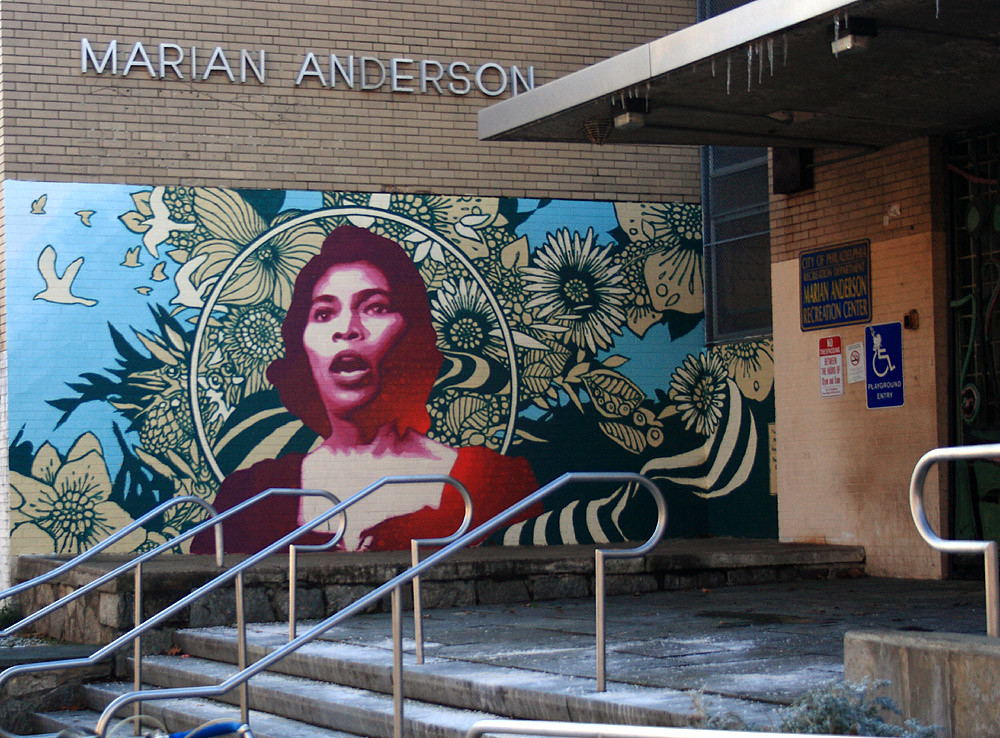
Marian Anderson Recreation Center,
Philadelphia
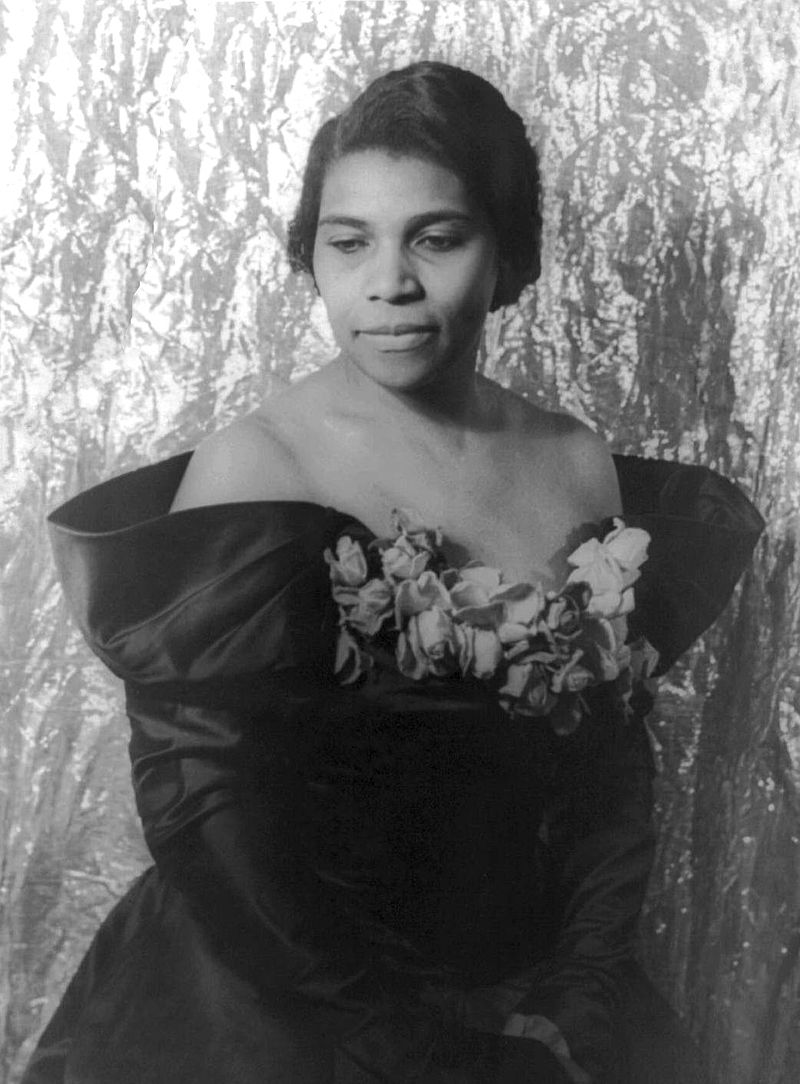
Marian Anderson is one of the most famous contralto singers of her time.  I wanted the children to know of her and her musical legacy because she is one of our own- growing up within walking distance of our school.  Many children in my classes have walked over to the playground at "Marian Anderson", but none knew who she was.


Anderson as Ulrica in
Un Ballo in Maschera
Marian Anderson (1897-1993) was born in Philadelphia and sang as a child at Union Baptist Church.  In spite of extreme racism and segregation she found great success as a classical vocalist, performing all over the world.  She was famous for her rich low voice and performed art song, opera and spirituals in concert.  She actually performed a role in an opera only once: Ulrica (a fortune-teller) in Giuseppe Verdi's "Un Ballo in Maschera" at the Metropolitan Opera in 1955, and was the first African-American to ever sing at the Met.

Instead of presenting her with another classical vocalist, I chose to play the aria (English translation here) from her Metropolitan Opera debut, and an example of her treatment of an African-American Spiritual.

We heard:
Re dell'abisso, affrettati (King of the depths, hurry), from Giuseppe Verdi's Un Ballo in Maschera, performed in 1955 at the Metropolitan Opera.
Nobody Knows the Trouble I've Seen, African American Spiritual.


I told the classes the story of how Marian Anderson returned to the USA from Europe and faced terrible racism that affected where and when she could perform, where could stay on tour and who could sit in the best seats in her audience.  She would often insist on vertical segregation instead of horizontal- ensuring that some of black audience members were able to sit in the orchestra section of the theater- many for the first time ever.  I explained that the singer was denied performance space at Constitution Hall by the Daughter of the American Revolution (who owned it at the time), and because of the the first lady, Eleanor Roosevelt, resigned from that organization and that she and the president arranged for Anderson to sing an open air concert on Easter Sunday of 1939 in front of the Lincoln Memorial.  When I told the children that more than 75,000 people came out to hear her, they couldn't believe it. Some even doubted the photograph was real!


The lesson plan is here.
The visual aides are here.
The drawing pages are here.

Enjoy!

Sunday, May 22, 2016

Lesson 9: Queens of Improvisation

My daughter is constantly making up songs or singing variations on songs- either because she has another idea, or, more likely, because she just doesn't remember the tune (good luck getting her to admit it!).  I wanted to show the children that this is a kind of improvisation, and that famous singers have been doing it for ages.


The Egyptian singer Umm Kulthum (1898(?)-1975) is also called the "Star of the East"- with an extensive career, she had a great influence on the world's understanding of Arab music for most of the 20th century.  I had to choose a short segment of the song "Enta Oumry" إنت عمري, you are my life to play for the children because most of her songs are quite long: 25-90 minutes! Her technique of improvisation is a style of old classical arabic song- she repeats a section over and over, improvising each time. Concerts could be hours long, and her voice was so strong, apparently she was famous for singing without a microphone. "Enta Oumry" was composed by Mohammed Abdel Wahab and written by Ahmad Sahafiq Kamel. The recording that I shared was made in 1964 in Egypt.


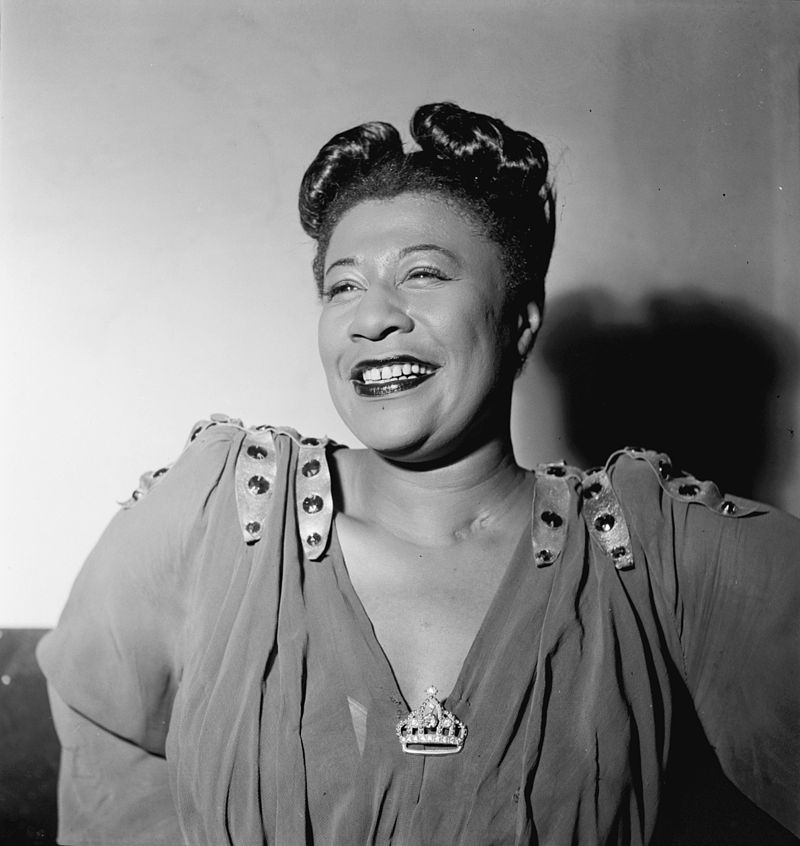
Ella Fitzgerald (Gottlieb 02871).jpgIn the United States we have our own master of improvisation- the great Ella Fitzgerald (1917-1996), who bears the moniker "First Lady of Song". I played a recording that is particularly rich in its demonstration of her scatting virtuosity: How High the Moon, performed live in Berlin in 1960. I tried to point out her quoting other songs while improvising, even though I knew the children weren't familiar with them. Her scatting is so unique that it gives an idea of the special acrobatics she is performing vocally, even without the background knowledge of the great American songbook.

I loved sharing these artists side-by-side: two women who came to define the best of their genre, one celebrating something old and exquisite, and the other creating something fabulously new.

Enta Oumry, Umm Kulthum
How High the Moon, Ella Fitzgerald

Here is the lesson plan.
Here is the drawing sheet.
Here are the visual aides.

Enjoy!

Friday, May 6, 2016

Lesson 8: A man with a guitar

It is quite likely that ever since the guitar was invented (possibly in Spain in the 16th century), men have held it in their arms while serenading a beloved.

One of my students is Italian.  I wanted to play something Italian for him, but having studied both musicology and Italian Studies, I knew that Italian music changes a great deal depending of where in Italy you go. I was finally able to meet his lovely mother, who shared that she and her husband were from Naples.  Neopolitan classical songs are world-famous, being popularized by the Three Tenors who included them in their concert repertoire.


Roberto Murolo (1912-2003) spent his life collecting and celebrating the "Canzone Napoletane."  Reginella ("Queenie") is a love song written by Libero Bovio.  It's a lament accompanied by guitar, singing of a lost love.  You can read a translation here. The song is written in the Neopolitan dialect, and not immediately comprehensible to modern-day Italian-speakers.


Performing in the USA around the same time was country musician Hank Williams (1923-1953).  Williams was born in Alabama and played throughout the country.  He was taught to play guitar by Rufus Payne, a black street performer.  One of my students commented that it sounded like the blues, and I explained that this was because he learned to play from a blues guitarist.

Williams wrote and recorded the song I'm so lonesome I could cry in 1949.  Unlike Reginella, he is accompanied by electric guitar, rhythm guitar, steel guitar, bass and fiddle.
I liked pairing these songs because they are so similar.  Both use the images of birds to convey their lonely feeling.

All over the world, people listen to the birds, hold their guitars and sing of lost love.

For the drawing pages, click here.
For the lesson plan, click here.
For the visual aides, click here.

Enjoy!

Friday, March 18, 2016

Lesson 7: Homelands

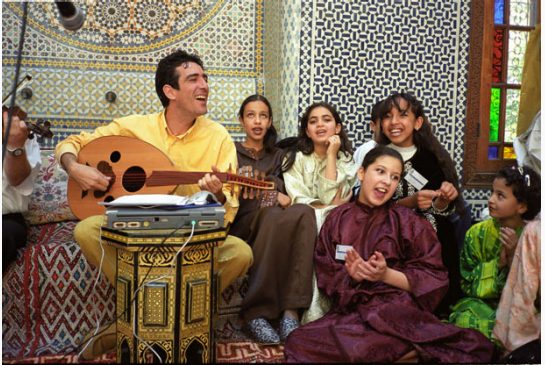
Nouamane Lahlou
This lesson came together surprisingly this week.  I'd been working on gathering Moroccan music for a long time, because one of the assistant teachers that I work with is from Morocco.  I like to pick music from cultures that are represented in the classrooms so that the children can learn about the cultures that are all around them.  Unfortunately I don't read or speak Arabic, and it is quite difficult to navigate search engines in a language you don't understand!  I had some great help from our assistant teacher  who recommended I look up the famous Moroccan singer Nouamane Lahlou.


Dervish

Yesterday was St Patrick's Day, so I thought it was a good time to share some lovely Irish music as well.  Dervish is a traditional Irish ensemble fronted by the singer Cathy Jordan.  I quickly came upon "Welcome Poor Paddy Home" on youtube and was enchanted.  It's a beautiful song about returning to a beloved home.  Aha!  I suspected I'd be able to find 2 songs about a beloved homeland, and I easily did.  


Very little of Lahlou's lyrics are translated into English on the web, but it was obvious that his favorite topic is his homeland of Morocco.  "Bledi" means "my country", and is a song that he wrote when homesick while touring in the US.  It tells of how lovely Morocco is and how enchanting the people are.  He sings that if you don't understand how wonderful it is you should come to Morocco and experience it for yourself. 


I couldn't successfully convey this in class because we weren't watching the musicians, but I thought there was also a similarity between the ensembles. I found videos of both surrounded by audiences that were joining in and sharing the music together.  It seemed that both the music of Ireland and that of Morocco easily lend themselves to a casual and welcoming atmosphere.   

We heard Welcome Poor Paddy Home, Performed by Dervish, and
"Bladi"/ My Country, by Nouamane Lahlou.  (The song is #18 on the page.)


Here is the lesson plan.
Here is the coloring page. Print one for each student (double sided).
Here are the visual aides. If you have the capacity to project these, that would be great.  I have mine in a binder and walk around the tables giving everyone a closer look.


I also pointed out the wide geographical origins of the pieces on a large world map.  

Enjoy!

Monday, February 22, 2016

Lesson 6: A New Year

With all the Chinese New Year revelry in the air, I wanted to share some New Year's celebratory music.  I chose to  show how different people all over the world are inspired to sing as the old year turns to the new. I found a site that lists many songs for Chinese New Year here.

Gongxi Gongxi/ Greetings Greetings; a traditional Chinese New Year's song. Translation can be found here.  Listen on Youtube here.
Avinu Malkeinu/ God hear us...; a traditional Jewish New Year's sung prayer.  This version composed by Max Janowski and sung by Barbra Streisand.  Listen on Youtube here.


Barbra Streisand

For a Reform Jewish perspective on the history of Avinu Malkeinu, you can read here.  General information can be found at Wikipedia.


I showed them pictures of the dragon being paraded down a street for the Chinese New Year, and we talked about our own Philadelphia Mummer's parade where people also dress up and parade down the street on January 1st.  I told the children about Jewish New Year/ Rosh Hashana and Yom Kippur that occur earlier in the Fall, and how Jewish people go to synagogue and sing prayers together and listen to a cantor sing as well.  


We talked about how though the Chinese New Year song was from China, it is now sung in Chinatowns all over the world, including our own city.  I taught them that although Max Janowski was born in Berlin, Germany, he worked in Japan early in his career and spent most of his life in Chicago.  Music truly travels the world. 

One class loved the joyful and upbeat Gongxi Gongxi, and another loved the famously rich voice of Barbara Streisand.  They all seemed to enjoy the lesson. 

Here is the lesson plan.
Here is the coloring page. Print one for each student (double sided).
Here are the visual aides.  If you have the capacity to project these, that would be great.  I have mine in a binder and walk around the tables giving everyone a closer look.

I also pointed out the wide geographical origins of the pieces on a large world map.  


Enjoy!

Sunday, February 7, 2016

Music and Play: Snow and Valentines

Last Friday I brought songs, a poem and games from Kodaly in Kindergarten, and celebrated the tiny bit of snow that had fallen that morning by singing about snowflakes and mittens.

I also introduced Kodaly hand signs from Do to Sol.  We started with our pitch warm-up, which is matching pitches, rising and crouching depending on how high or low the note is.  Then I had everyone sit and watch me sing the scale Do- Re- Mi- Fa- Sol, showing the hand shapes and encouraging them to copy and sing along.  I was amazed at their unison singing!  All the classes did wonderfully and I am sure we will continue with hand signs.

Mitten
Thumbs in the thumb place,
Fingers all together.
This is the song we
Sing in mitten weather.

When it is cold it
Doesn't matter whether
Mittens are wool or
Made of finest leather.

This is the song we
Sing in mitten weather,
Thumbs in the thumb place,
Fingers all together.

See the Pretty Snow Flakes
See the pretty snowflakes
Falling from the sky,
On the walls and house-tops
Soft and thick they lie.


We talked about the Groundhog's prediction and I read this poem:

A Good Day for Groundhogs
by Ivy Eastwick

The funny little groundhog
left his funny little hole
Without a word to Porcupine
To Weasel or to Mole.

He sniffed at the air which
was very cold and chill.
He stared at the sky which
was wild above the hill.

He kicked up his hind legs,
made a happy little sound,
And danced a merry jig upon
the icy winter ground.

Then he called to his family
"The Winter's almost done!
Spring is round the corner,
Let's have fun!"

Then, of course, we sang a groundhog song!

Ground Hog Song
Winter goodbye, Blue is the sky.
You can't stay round this place,
Groundhog has shown his face,
Winter goodbye, Blue is the sky.

We talked about Valentine's Day, which is coming up, and sang a Valentine's song, learning about rests and walking in time to the beat.

Valentine
Valentine, Valentine, red and blue,
Valentine, Valentine, I love you.